Chrome extension for Facebook Marketplace
Know what breaks before you go look at it
Curb Check reads used-car listings as you scroll and flags the ones worth your Saturday — which engine to avoid, what breaks in that model year, how many miles is too many for that specific car, and exactly what to ask the seller.
The trial takes an email, not a card — nothing to cancel, nothing auto-charges. 30-day full refund if it's not for you.
Works in Chrome on a desktop or laptop — Windows, Mac or Linux. Not at your own computer right now? Email yourself the link. Curb Check runs on desktop Chrome — phones can't run browser extensions. Send yourself the link and install tonight:
- $29 onceNo subscription, no renewal.
- 7 days freeThe trial takes an email, not a card.
- 30-day refundFull refund if it's not for you.
- Collects nothingNo account, no tracking, no cookies.
The colour code
Three answers, and that's it
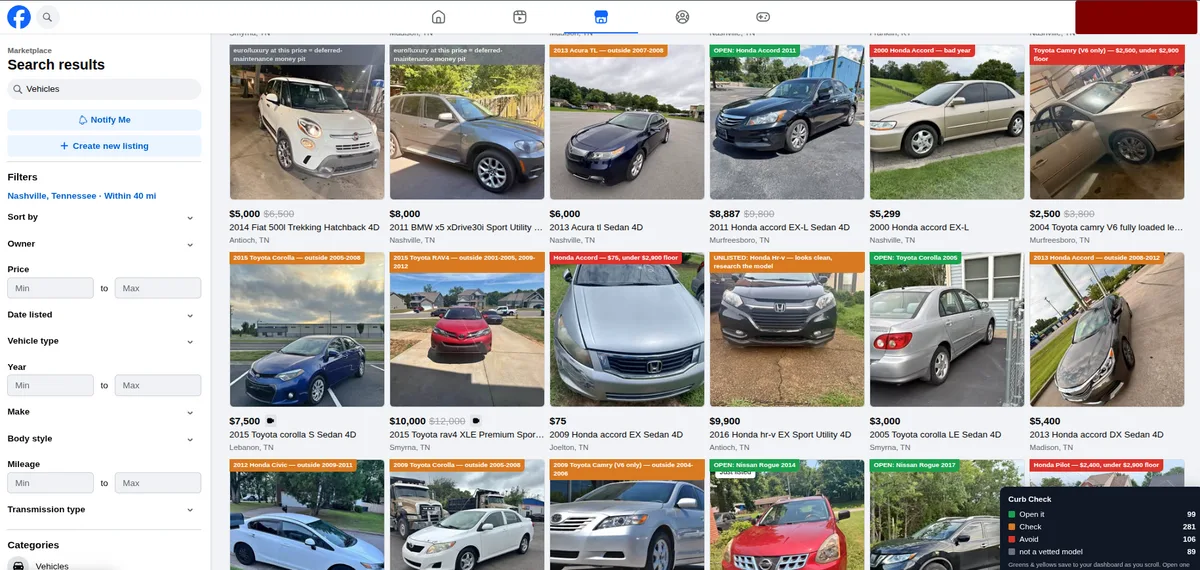
Curb Check colours every listing one of three ways. You'll recognise them within about ten seconds of scrolling. Anything it doesn't have researched data on stays grey — no answer, not a warning.
Go see it
Good year, sane mileage, price in range, nothing alarming in the description. Message the seller today.
Check first
Could be fine, could be a headache. Something needs an answer before you drive across town for it.
Walk away
A known bad engine year, miles well past what this model survives, or a price that only makes sense if something's wrong.
Not covered
No researched data on this one. Not a warning — it just means you're on your own for that listing.
How it works
You browse the way you already do
-
Add it to Chrome
Install from the Chrome Web Store, then confirm the trial email. No payment details needed.
-
Scroll Marketplace
Coloured bars appear on listings as they load. A small counter in the corner tallies how many of each colour you've passed.
-
Open the ones worth it
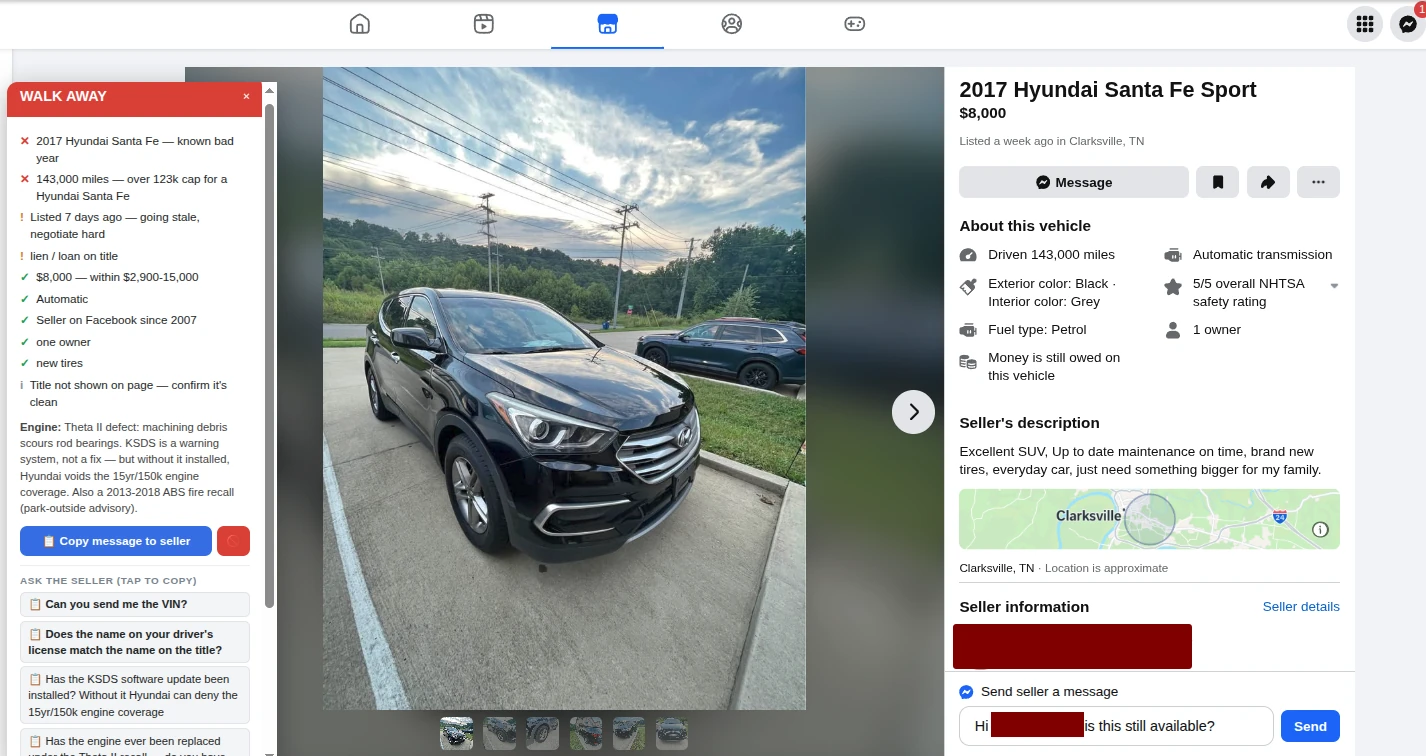
Click into a car and a panel appears beside it with the reasoning, the engine notes, and the questions to ask.
The panel
The reasoning, not just a colour
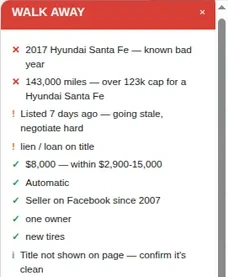
Every check that passed or failed, what's known about that engine in that year, and what you can't establish without standing in front of the car.
A 2013 Kia Sorento has a documented engine defect. A 2005 Honda Pilot can destroy its own transmission. A 2010 Subaru Forester will probably need head gaskets. Forty-six models, year by year — not generic advice.
The message
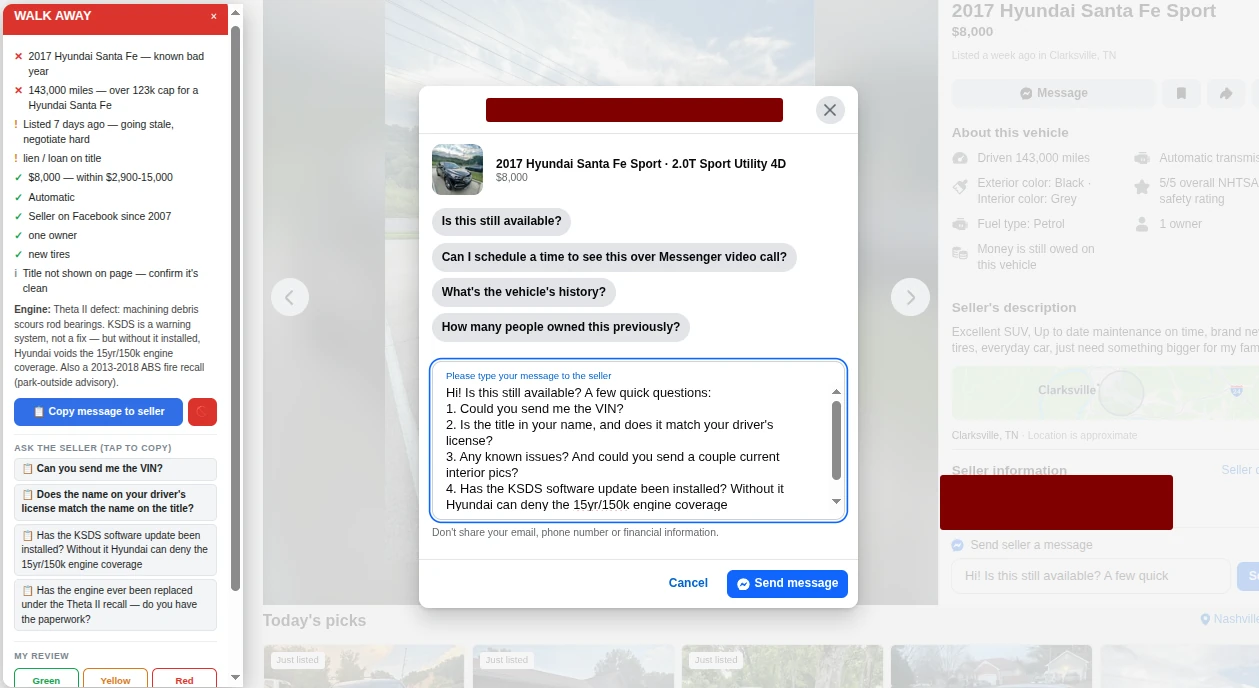
It writes your first message
Every listing gets questions specific to that model and that year — then one click copies the whole message, ready to paste.
Not "is this still available." More like: has the KSDS software update been installed? — because without it, Hyundai can decline the fifteen-year engine coverage.
A seller either answers that straight away or doesn't. Both tell you something.
The dashboard
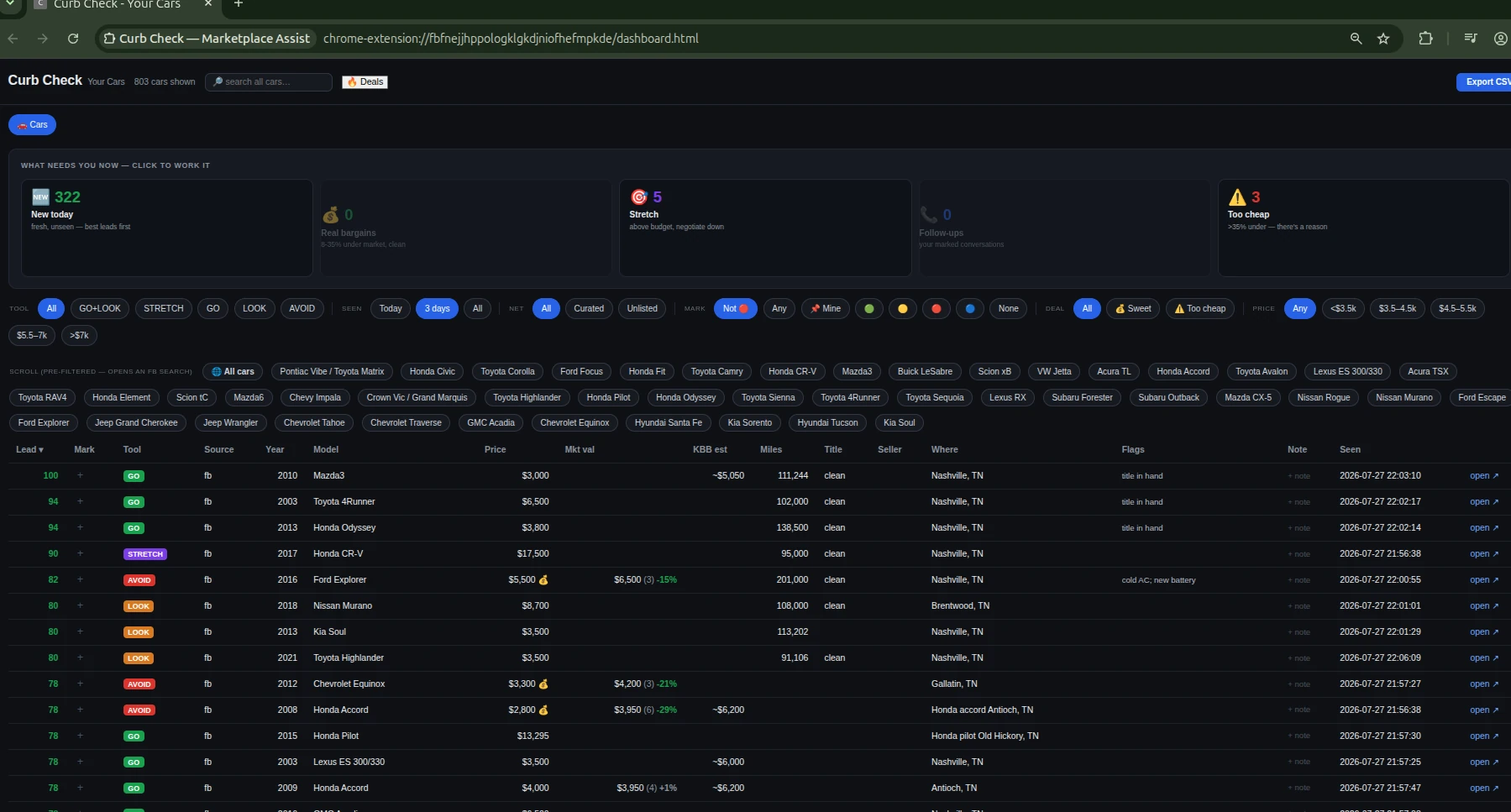
Every car you look at is saved
Prices, mileage, verdicts and your own notes collect in a private list on your own computer — so you can compare Saturday's cars against Tuesday's instead of losing them in the scroll.
No account, no upload, nobody else can see it. Export the lot to a spreadsheet whenever you want.
How it stays out of trouble
It reads. It doesn't act.
Curb Check makes no requests to Facebook. It reads the page your browser has already loaded — the same thing on the screen in front of you — and adds a colour to it.
The full detail on a car is read only when you open that car yourself. Nothing is scraped and nothing is automated. It never:
- Opens a listing on its own
- Clicks anything
- Sends a message
- Fetches pages in the background
If you've seen accounts restricted over automated tools, that's the behaviour this avoids by design — not by asking nicely, but by never doing it.
Why it exists
The car that proved the first version wrong
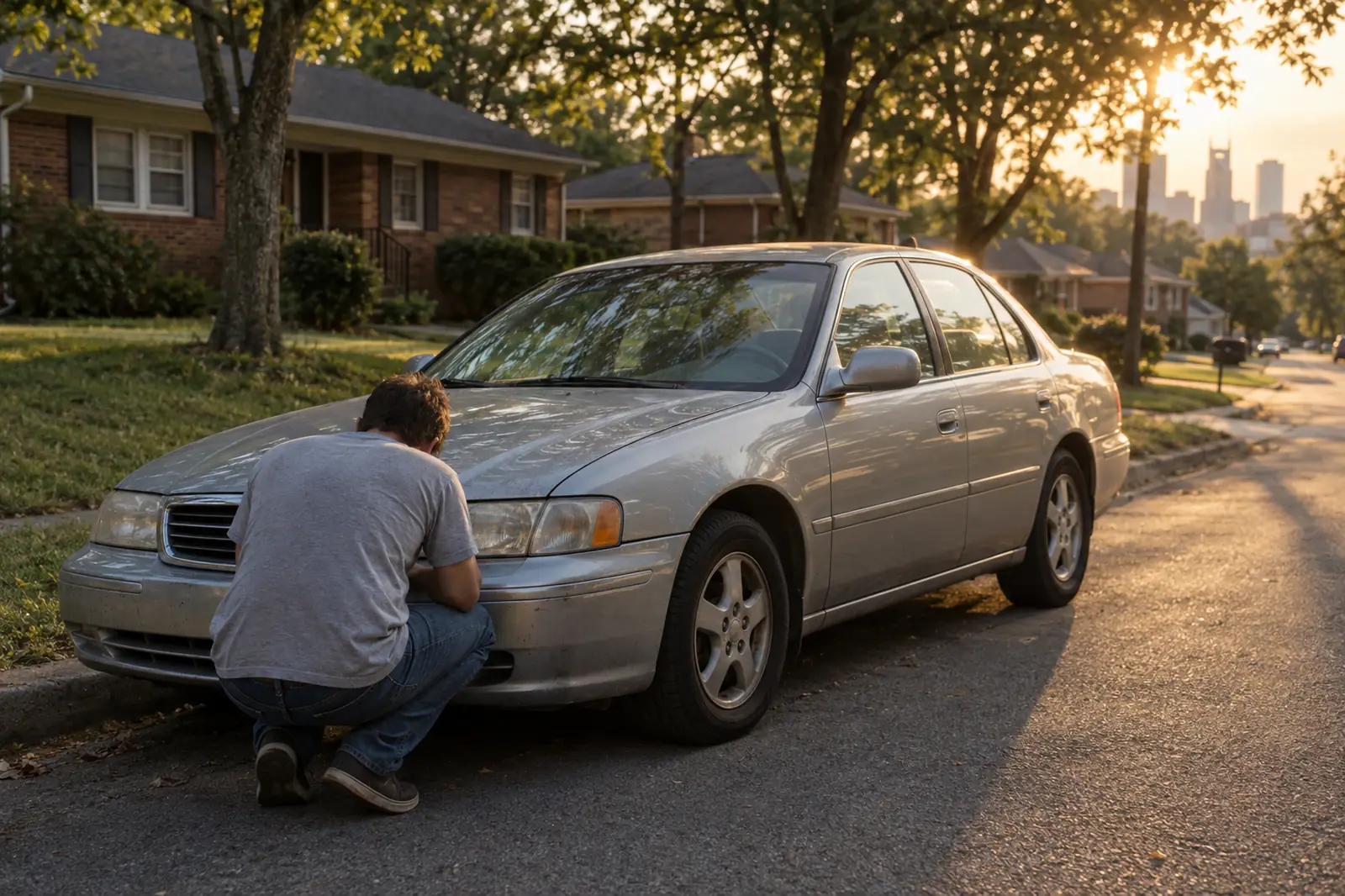
Early on, the tool used one flat mileage limit for everything. Then it told me to walk away from the 2007 Toyota Avalon I was looking at for my daughter — which I bought anyway, after talking the $6,000 asking price down to cover tires and an alignment.
A blanket mileage rule doesn't describe reality. A Toyota Avalon at 180,000 miles is a normal used car. A turbocharged hot hatch at 180,000 miles is a project.
So the rule was rebuilt around what each model actually survives, and every car already in the database was re-scored against it.
Read the whole story →Coverage
The cars it covers
Forty-six models, researched year by year. Anything not on this list shows grey — no answer, not a warning.
- Toyota
- Camry (V6 only), Corolla, Avalon, RAV4, Highlander, 4Runner, Sienna, Sequoia, Matrix
- Honda
- Civic, Accord, CR-V, Fit, Element, Pilot, Odyssey
- Lexus
- ES 300/330, RX
- Acura
- TL, TSX
- Scion
- xB, tC
- Mazda
- Mazda3, Mazda6, CX-5
- Subaru
- Forester, Outback
- Nissan
- Rogue, Murano
- Ford
- Focus, Escape, Explorer, Crown Victoria
- Mercury
- Grand Marquis
- Chevrolet
- Impala (3.8 only), Equinox, Tahoe, Traverse
- GMC
- Acadia
- Buick
- LeSabre
- Jeep
- Grand Cherokee, Wrangler
- Hyundai
- Santa Fe, Tucson
- Kia
- Sorento, Soul
- Volkswagen
- Jetta
- Pontiac
- Vibe
Two are deliberately narrow: the Camry is scored for the V6 only and the Impala for the 3.8 only. Listings for the other engines in those cars show grey.
Free guide
I need one that won't break
A first car, a college car, a commuter. Cheap to buy, cheap to keep, boring in the best way. Start with the free checks most buyers don't know exist.
Start here →I want something fun
Sports and luxury cars that lost eighty-five percent of their sticker price and none of their nerve — and the ones that will bankrupt you instead.
Check your next search before you drive anywhere
Seven days free with an email. Then $29 once — no subscription, nothing renews.
The trial takes an email, not a card — nothing to cancel, nothing auto-charges. 30-day full refund if it's not for you.
Chrome on Windows, Mac or Linux. Installs in under a minute. Curb Check runs on desktop Chrome — phones can't run browser extensions. Send yourself the link and install tonight: